
AIoT: How AI and IoT Are Creating Smarter Connected Systems
AIoT: How AI and IoT Are Creating Smarter Connected Systems
The Internet of Things (IoT) has transformed the way businesses connect devices, collect data, and monitor physical environments. But collecting data is only the beginning.
The next step is making that data intelligent.
AIoT, or Artificial Intelligence of Things, combines artificial intelligence with IoT to create connected systems that can analyze information, identify patterns, make decisions, and trigger actions. The International Telecommunication Union (ITU) defines AIoT as the combination of AI technologies with IoT infrastructure to improve IoT operations, human-machine interaction, data management, and analytics.
Instead of simply asking, “What is happening?”, an AIoT system can help answer:
“What is happening, what does it mean, and what should happen next?”
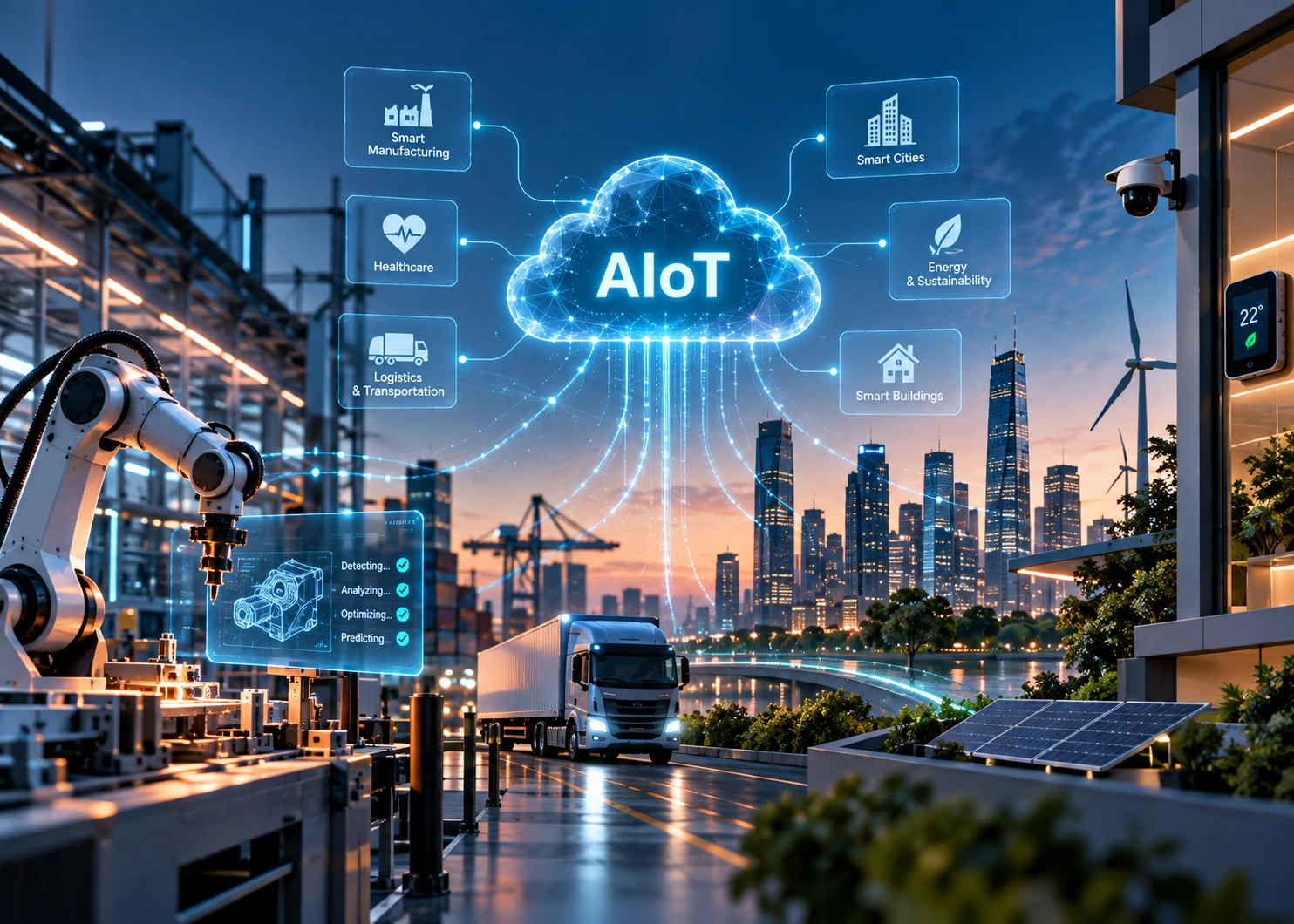
From smart manufacturing and healthcare to logistics, energy, retail, and smart buildings, AIoT is creating a new generation of intelligent connected systems.
What Is AIoT?
AIoT stands for Artificial Intelligence of Things. It refers to the integration of artificial intelligence and Internet of Things technologies to make connected devices and systems more intelligent.
Traditional IoT primarily focuses on connecting physical devices and collecting information.
For example, a factory may have sensors that monitor:
- Temperature
- Pressure
- Vibration
- Energy consumption
- Machine performance
The sensors collect information and send it to a platform where employees can monitor the data.
AIoT adds an intelligence layer to this process.
An AIoT system can analyze sensor data, identify unusual patterns, predict potential problems, and support or automate decisions.
A simple way to understand the difference is:
IoT = Connect and collect
AI = Analyze and learn
AIoT = Connect, analyze, predict, and act
The ITU’s AIoT framework describes AI capabilities being deployed across devices, edge infrastructure, and cloud systems depending on the application’s requirements.
How Does AIoT Work?
AIoT typically combines three major layers:
1. Devices and Sensors
Devices interact directly with the physical world.
These can include:
- Industrial sensors
- Cameras
- Wearables
- Smart meters
- GPS trackers
- Connected vehicles
- Medical devices
- Environmental sensors
- Robotics
- Smart appliances
These devices generate information that AI systems can analyze.
2. Edge Computing
The edge sits between devices and centralized cloud infrastructure.
Instead of sending every piece of raw data to the cloud, an edge system can process information closer to where it is generated.
For example, a factory camera could analyze a product locally and identify a manufacturing defect before sending relevant information to a central platform.
This can reduce latency, bandwidth requirements, and unnecessary data transmission.
The ITU describes the edge as a regional processing layer that can aggregate device data, perform preprocessing, and support fast local decisions, while the cloud handles broader coordination and computationally intensive workloads.
3. Cloud Infrastructure
Cloud platforms provide large-scale computing and storage capabilities.
They can be used for:
- AI model training
- Historical data analysis
- Centralized device management
- Data storage
- Cross-location analytics
- Model updates
- Business intelligence
This creates a device-edge-cloud architecture, where each layer performs a different role.
Device: Sense and execute
Edge: Process and respond quickly
Cloud: Analyze, coordinate, and scale
AIoT vs IoT: What’s the Difference?
The main difference is intelligence.
| Traditional IoT | AIoT |
| Connects devices | Connects intelligent devices |
| Collects data | Analyzes data |
| Often relies on predefined rules | Can use AI and machine learning |
| Primarily monitors conditions | Can predict conditions |
| Human interprets much of the data | AI can identify patterns automatically |
| Automation is often rule-based | Automation can become adaptive |
For example, a traditional IoT system might notify a factory manager when machine temperature exceeds a predefined threshold.
An AIoT system could analyze temperature, vibration, operating speed, historical maintenance data, and other signals to identify an emerging equipment problem.
That difference is significant.
IoT provides the connected infrastructure.
AI provides the intelligence.
AIoT brings them together.
Why Is AIoT Important in 2026?
Businesses are generating enormous amounts of data from connected devices.
The challenge is no longer simply collecting information. The challenge is determining what that information means and how to act on it quickly.
AI can help transform raw IoT data into actionable intelligence.
This is also why AIoT is increasingly moving toward on-device AI and edge intelligence. ITU research notes that deploying AI capabilities on devices and at the edge can support real-time processing, reduce latency, improve privacy, and reduce the amount of information that needs to be sent to the cloud.
A newer ITU recommendation approved in June 2026 also addresses on-device AIoT for robot services, highlighting the movement toward devices that can process information, make decisions, and execute AI workloads locally.
This is especially important for applications where decisions need to happen quickly.
Key Benefits of AIoT
Real-Time Decision-Making
AIoT systems can analyze information as it is generated.
Instead of waiting for a person to review a dashboard, an AI system can identify an unusual condition and initiate an appropriate response.
For example:
Sensor → Detects abnormal vibration → AI analyzes pattern → Risk identified → Alert generated
This can help businesses respond faster to operational problems.
Predictive Maintenance
Predictive maintenance is one of the most practical AIoT applications.
Connected machines can continuously generate information about their operating conditions.
AI can analyze this information to identify patterns associated with equipment problems.
Businesses can then use these insights to schedule maintenance before a serious failure occurs.
Operational Automation
AIoT can connect sensing, intelligence, and action.
For example:
Temperature sensor → AI detects overheating → System evaluates risk → Equipment adjusts → Operations team receives notification
This creates a closed-loop system in which technology can respond to changing conditions.
Reduced Latency
When AI processing takes place closer to the device, systems do not always need to send data to a distant cloud environment before making a decision.
This can be valuable for:
- Industrial automation
- Robotics
- Connected vehicles
- Security systems
- Healthcare devices
- Smart infrastructure
Better Data Utilization
IoT devices can generate massive amounts of information.
AI can help identify which information is useful, which patterns matter, and which events require attention.
Instead of overwhelming employees with raw data, AIoT can focus attention on meaningful insights.
AIoT Use Cases Across Industries
AIoT in Manufacturing
Manufacturing is one of the strongest applications for intelligent connected systems.
Factories can use sensors and connected equipment to monitor:
- Production lines
- Machine vibration
- Temperature
- Energy consumption
- Product quality
- Equipment performance
AI can analyze these signals to identify anomalies, predict maintenance requirements, and improve operational efficiency.
AIoT can also work alongside robotics and computer vision to create more intelligent production environments.
AIoT in Healthcare
AIoT can connect medical devices, wearable technology, monitoring equipment, and healthcare platforms.
Potential applications include:
- Remote patient monitoring
- Smart medical devices
- Wearable health monitoring
- Equipment monitoring
- Environmental monitoring
- Automated alerts
Healthcare applications require particularly careful consideration of privacy, security, compliance, and data governance.
AIoT in Logistics
Connected vehicles, GPS systems, warehouse sensors, cameras, and tracking devices can generate large amounts of operational data.
AI can analyze this information to support:
- Route optimization
- Fleet monitoring
- Predictive vehicle maintenance
- Asset tracking
- Warehouse automation
- Delivery optimization
The result can be a more responsive logistics operation where businesses have greater visibility into assets and transportation processes.
AIoT in Smart Buildings
AIoT can connect:
- HVAC systems
- Lighting
- Occupancy sensors
- Security systems
- Access control
- Energy meters
AI can then analyze occupancy and environmental data to optimize building operations.
For example, a smart building could adjust temperature and lighting according to occupancy patterns rather than relying entirely on fixed schedules.
AIoT in Retail
Retail businesses can use connected cameras, inventory sensors, smart shelves, and point-of-sale systems to generate operational data.
AI can analyze this information to support:
- Inventory forecasting
- Demand prediction
- Store optimization
- Customer experience
- Loss prevention
- Personalized experiences
AIoT in Smart Cities
Cities can connect infrastructure such as:
- Traffic systems
- Environmental sensors
- Parking systems
- Street lighting
- Public transportation
- Waste management
AI can analyze information from these systems to help city operators understand patterns and respond more efficiently.
Edge AI and the Future of AIoT
One of the most important developments in AIoT is the growth of Edge AI.
Edge AI means running AI models closer to where data is generated rather than relying entirely on centralized cloud processing.
Consider an industrial camera.
Traditional approach:
Camera → Cloud → AI analysis → Response
Edge AI approach:
Camera → Local AI → Decision → Response
The second approach can reduce the amount of data sent to the cloud and support faster responses.
However, edge devices often have limited computing power, storage, and energy resources. AI models therefore may need to be optimized for the hardware on which they run.
The ITU notes that AIoT can distribute intelligence across devices, edge nodes, and cloud infrastructure, allowing systems to balance local processing with centralized computing.
AIoT Security Challenges
AIoT also introduces new security considerations.
A traditional IoT environment already has devices, networks, applications, and data that need protection.
Adding AI introduces additional risks around models, training data, inference, and AI-driven decisions.
The ITU’s 2025 technical report identifies AIoT security concerns across five layers: hardware, system, data, network, and application.
Potential risks include:
- Unauthorized device access
- Insecure firmware
- Data privacy breaches
- Network attacks
- Model theft
- Data poisoning
- Adversarial attacks
- Compromised sensors
- Insecure device updates
- Resource overload
Security therefore needs to be considered from the beginning of an AIoT project.
Businesses should evaluate device security, authentication, encryption, access controls, network protection, AI model security, monitoring, and update mechanisms.
How Businesses Can Adopt AIoT
Companies do not need to connect every device and deploy AI everywhere at once.
A more practical approach is to start with a specific business problem.
Step 1: Identify the Business Problem
Determine where connected intelligence could create measurable value.
For example:
- Reduce machine downtime
- Improve energy efficiency
- Monitor assets
- Improve production quality
- Optimize logistics
Step 2: Identify the Data
Determine which devices, sensors, applications, and systems provide the information required.
Step 3: Design the Architecture
Determine which workloads should run on the device, at the edge, or in the cloud.
Step 4: Develop the AI Layer
Choose the appropriate technology, such as:
- Machine learning
- Computer vision
- Predictive analytics
- Anomaly detection
- Generative AI
- Optimization models
Step 5: Connect the Ecosystem
Integrate devices with IoT platforms, APIs, databases, enterprise systems, and cloud infrastructure.
Step 6: Secure the System
Implement security across devices, networks, data, applications, and AI models.
Step 7: Measure Results
Track measurable business outcomes such as:
- Reduced downtime
- Faster response times
- Lower operating costs
- Reduced energy consumption
- Improved productivity
- Better asset utilization
What Is the Future of AIoT?
AIoT is moving beyond connected devices toward increasingly intelligent physical systems.
The combination of AI, IoT, edge computing, cloud infrastructure, computer vision, robotics, and automation can create systems capable of sensing their environment, interpreting information, predicting outcomes, and taking action.
The ITU’s 2026 AIoT reference model includes requirements covering devices, edge, cloud, data management, interoperability, security, privacy, trust, and operational considerations, showing that AIoT is developing into a broader technology architecture rather than simply a combination of two technologies.
The long-term shift can be summarized simply:
IoT connects things.
AI understands data.
AIoT connects intelligence to the physical world.
Final Thoughts
AIoT is changing the role of connected technology.
Traditional IoT helped businesses collect information from physical devices. AIoT adds intelligence that can help organizations interpret that information, predict events, automate decisions, and respond to changing conditions.
From smart manufacturing and healthcare to logistics, retail, energy, and smart cities, AIoT can create more responsive and intelligent digital ecosystems.
But successful AIoT implementation requires more than sensors and an AI model. Businesses need reliable data, scalable architecture, secure devices, appropriate edge and cloud infrastructure, and a clear connection between technology and business objectives.
TechVaders helps businesses build AI-powered digital ecosystems by combining AI, IoT, cloud technologies, automation, and intelligent applications.
Whether the goal is predictive maintenance, connected products, smart infrastructure, or an intelligent IoT platform, AIoT can provide the foundation for turning connected data into actionable intelligence.
Frequently Asked Questions
What is AIoT?
AIoT stands for Artificial Intelligence of Things. It combines AI with IoT infrastructure to create connected systems capable of analyzing data, making intelligent decisions, and supporting automated actions.
What is the difference between AI and IoT?
IoT connects physical devices and collects data, while AI analyzes information and generates predictions, recommendations, or decisions. AIoT combines both capabilities.
What are the benefits of AIoT?
AIoT can support real-time decision-making, predictive maintenance, automation, improved operational efficiency, reduced latency, and better use of data.
What is Edge AI?
Edge AI involves running AI workloads closer to where data is generated, such as on IoT devices or local edge infrastructure. This can reduce latency and the amount of data sent to centralized cloud systems.
What are common AIoT applications?
Common applications include predictive maintenance, smart manufacturing, healthcare monitoring, logistics, connected vehicles, smart buildings, smart cities, energy management, and retail systems.
Is AIoT secure?
AIoT introduces security considerations across devices, networks, data, AI models, and applications. A secure AIoT architecture should address these layers throughout the system lifecycle.
How can a business start using AIoT?
A business can begin by identifying one operational problem, determining the necessary data and devices, designing a device-edge-cloud architecture, developing the appropriate AI capability, securing the system, and measuring the business outcome.
Uncategorized
AI-Native Software Development: How AI Is Changing the Way Software Is Built
Software development is entering a new phase. Artificial intelligence is no longer being used only as a coding assistant that suggests a few lines of code. AI is increasingly becoming part of the entire software development lifecycle—from planning and architecture to coding, testing, deployment, monitoring, and maintenance. This shift is known as AI-native software development.…
Uncategorized
How to Migrate a Domain Safely Without Downtime
Your domain is more than a web address. It connects customers to your website, email, applications, landing pages, and other digital services. When you need to move your domain to a new registrar, poor planning can lead to unnecessary downtime, broken email, DNS problems, or delays. The good news is that domain migration does not…
Uncategorized
GPT-6 Astra Explained: Is It Really AGI and What Does It Mean for Businesses?
Artificial intelligence is moving from systems that answer questions to systems that can reason, use computers, make decisions, and complete multi-step tasks. The arrival of GPT-6 Astra represents an important step in that transition. OpenAI describes Astra as its most capable model to date, with major advances in computer use, software engineering, cybersecurity, scientific reasoning,…
Delivering scalable software that drives real business growth.

